


TL;DR:
- Omega-3s enhance recovery, reduce inflammation, and support muscle repair in athletes.
- Consistent intake of EPA and DHA is crucial for maximizing athletic performance benefits.
- Supplement quality and proper dosing are key, especially for high-volume or injured athletes.
Omega-3 fatty acids have long been associated with heart health, but if that’s where your understanding stops, you’re leaving serious gains on the table. For athletes training at any level, these essential fats play a far more targeted role: accelerating recovery, reducing inflammation, sharpening focus, and supporting the brain under physical stress. The science has moved well beyond cardiovascular protection. Recent research now maps omega-3s directly to endurance capacity, muscle repair, immune resilience, and even neuroprotection for contact sport athletes. This guide breaks down the mechanisms, the evidence, and the practical steps you need to make omega-3 work properly for your training.
Table of Contents
- Why omega-3 intake is different for athletes
- How omega-3 supports recovery, muscle soreness, and endurance
- Inflammation reduction, brain health, and immune function
- When omega-3 matters most: Practical guidance for athletes
- What most athletes get wrong about omega-3 supplementation
- Explore top supplements for performance and recovery
- Frequently asked questions
Key Takeaways
| Point | Details |
|---|---|
| Athletes face higher omega-3 needs | Intensive training increases risk of deficiency, making omega-3 crucial for peak performance and recovery. |
| Recovery and inflammation benefits | Omega-3s support faster muscle recovery, reduce soreness, and modulate inflammation at the cellular level. |
| Brain, sleep, and immune gains | Beyond muscles, omega-3 improves neuroprotection, sleep quality, and immune responses in athletes. |
| Not a miracle, but a foundation | Benefits are most consistent for recovery and health; elite performance boosts are variable. |
Why omega-3 intake is different for athletes
Most general dietary guidelines for omega-3 intake are designed with sedentary adults in mind. Athletes operate in an entirely different physiological environment, and that gap matters. High training volumes, restrictive eating phases, and elevated metabolic demands all create conditions where omega-3 insufficiency becomes far more likely.
The International Society of Sports Nutrition confirms that athletes risk omega-3 insufficiency due to dietary patterns, particularly those following plant-based, calorie-restricted, or low-fat protocols. Even athletes eating well-rounded diets often fall short because the demand side of the equation is simply higher.
Omega-3 polyunsaturated fatty acids, specifically EPA (eicosapentaenoic acid) and DHA (docosahexaenoic acid), are incorporated directly into cell membranes throughout the body. This isn’t passive storage. Their presence changes how cells respond to stress, regulate inflammation, and communicate with one another. For a muscle fibre being repeatedly broken down and rebuilt, that cellular environment is everything.
Here’s a quick look at how omega-3 status affects key athletic markers:
| Marker | Low omega-3 status | Adequate omega-3 status |
|---|---|---|
| Inflammation after training | Elevated and prolonged | Reduced and resolved faster |
| Muscle soreness duration | Longer, more intense | Shorter, less severe |
| Endurance capacity | Reduced cardiovascular efficiency | Improved oxygen utilisation |
| Cognitive sharpness | Impaired under fatigue | Better maintained |
| Immune resilience | More susceptible to illness | Stronger response |
Athletes who are most at risk of low omega-3 status include:
- Vegans and vegetarians, who avoid marine sources of EPA and DHA
- Athletes in weight-class sports, who frequently restrict dietary fat
- Endurance athletes, whose high caloric output doesn’t always translate to micronutrient sufficiency
- Young athletes, who may not prioritise dietary variety
Understanding omega-3s role in performance starts with recognising that deficiency isn’t just a health issue. It’s a performance issue that compounds over time.
How omega-3 supports recovery, muscle soreness, and endurance
Recovery is where omega-3 supplementation earns its place in a serious athlete’s stack. The mechanisms are well-established and the practical outcomes are meaningful, particularly for those in the earlier stages of training or pushing into higher volumes.

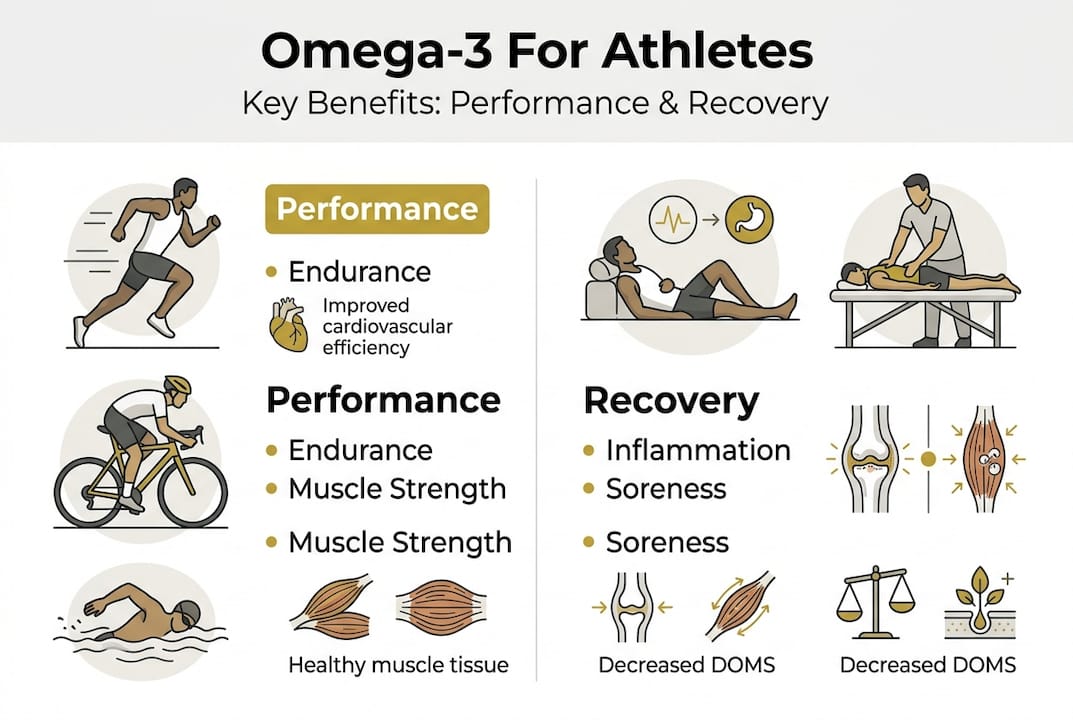
Research published in PMC12044634 shows that omega-3 reduces muscle soreness and aids recovery from exercise-induced muscle damage, especially in untrained individuals or those using higher doses. The mechanism centres on EPA and DHA’s ability to reduce the production of pro-inflammatory signalling molecules and speed up the resolution phase of muscle repair.
On the endurance side, the evidence is equally compelling. EPA and DHA supplementation enhances endurance capacity and cardiovascular function during aerobic exercise, a finding replicated across multiple controlled trials. Improved red blood cell flexibility, better oxygen delivery to working muscles, and reduced cardiac workload all contribute to this effect.
Here’s how omega-3 compares in its recovery impact across different athlete profiles:
| Athlete type | Soreness reduction | Endurance benefit | Strength benefit |
|---|---|---|---|
| Beginners or recreational | Strong | Moderate to strong | Moderate |
| Trained amateurs | Moderate | Moderate | Moderate |
| Elite athletes | Mild | Mild | Inconsistent |
| Older athletes (40+) | Strong | Moderate | Strong |
To get the most from omega-3 supplementation for recovery, consider this practical approach:
- Take omega-3 consistently, not just on training days. Cellular incorporation takes weeks, not hours.
- Pair with post-training meals that contain some dietary fat to optimise absorption.
- Use higher doses during high-volume training blocks when muscle damage and inflammation are elevated.
- Monitor subjective recovery, including sleep quality and soreness, as early indicators of improved status.
- Combine with other recovery supplements for a more complete protocol.
Pro Tip: Take your omega-3 supplement with your largest post-training meal. Fat-soluble nutrients absorb significantly better alongside dietary fat, and this simple habit dramatically improves bioavailability over time.
“The anti-inflammatory and recovery benefits of omega-3 are most pronounced when supplementation is consistent and dosed appropriately for training load, not treated as an afterthought.”
Inflammation reduction, brain health, and immune function
Muscular recovery and endurance aren’t the only gains. Omega-3s operate at a system level, influencing inflammation, brain health, immunity, and sleep in ways that directly affect your ability to train consistently and perform under pressure.
The anti-inflammatory mechanism works through EPA and DHA’s incorporation into cell membranes, which reduces prostaglandin production, generates specialised pro-resolving mediators (SPMs), and decreases oxidative stress. This isn’t simply about feeling less sore. Chronic low-grade inflammation impairs adaptation to training, disrupts hormonal signalling, and accelerates tissue wear. Managing it effectively is foundational to long-term athletic development, and you can read more about inflammation management strategies to understand why this matters beyond sport.
For athletes in contact sports, the neuroprotective angle is particularly important. Repeated head impacts cause measurable neuroaxonal injury, and omega-3 supplementation has been shown to reduce the associated biomarkers of that damage. DHA is a primary structural component of brain tissue, making adequate intake genuinely protective for rugby players, boxers, and any athlete absorbing regular physical contact.
Beyond the brain, omega-3 also improves sleep quality and immune responses in athletes. Sleep is your most powerful recovery tool, and immune suppression after intense training is a well-known risk that leads to missed sessions and disrupted periodisation.
Key system-level benefits for athletes include:
- Reduced chronic inflammation, supporting better long-term adaptation
- Neuroprotection, particularly relevant for contact and collision sport athletes
- Improved sleep architecture, which enhances hormonal recovery overnight
- Stronger immune responses, reducing illness-related training interruptions
- Joint lubrication and comfort, supporting joint health and recovery over a long season
Pro Tip: Consistency is everything with omega-3. The neuroprotective and anti-inflammatory benefits build over weeks of steady intake, not days. Treat it like a foundational supplement, not a situational one, and you’ll see the difference in how you boost performance with supplements across a full training cycle.
When omega-3 matters most: Practical guidance for athletes
Knowing that omega-3 is beneficial is one thing. Knowing when and how to use it strategically is where most athletes fall short. The research is clear that effects are dose and duration dependent, and that context determines how much benefit you’ll actually experience.
The ISSN position stand confirms that optimal protocols depend on individual baseline levels, with higher risk athletes benefiting most from structured supplementation. Meanwhile, strength improvements from omega-3 during resistance training appear in a dose and duration dependent manner, though muscle hypertrophy results in young adults remain inconsistent.
A systematic review of omega-3 in sport found that elite athletes see inconsistent objective performance and strength recovery results, while recreational and amateur athletes tend to experience more measurable gains. This doesn’t mean elites shouldn’t supplement. It means the benefits shift towards recovery, cognition, and protection rather than raw output.
Here’s a practical framework for different athlete types:
- New or recreational athletes: Start with 2 to 3 grams EPA/DHA daily during initial training blocks to support adaptation and reduce soreness.
- Trained amateurs: Maintain 1 to 2 grams daily, increasing during high-volume phases or injury recovery periods.
- Elite athletes: Focus on consistent baseline intake of 2 grams daily, prioritising supplement quality for athletes and purity of the product.
- Older athletes (40+): Higher doses of 2 to 3 grams are particularly beneficial given greater inflammatory burden and slower recovery.
- Vegans and vegetarians: Use algae-derived DHA and EPA supplements, as ALA from plant sources converts poorly to active forms.
Athletes who benefit most from omega-3 supplementation:
- Those with low dietary fish intake or restricted fat consumption
- Athletes returning from injury or entering high-volume training
- Anyone combining omega-3 with amino acids and recovery protocols for a synergistic effect
- Contact sport athletes seeking neuroprotection
- Masters athletes managing inflammation and joint health across a long career
What most athletes get wrong about omega-3 supplementation
Here’s the uncomfortable reality: most athletes either expect too much from omega-3 or give up on it too quickly. Both responses miss the point entirely.
Omega-3 is not a performance booster in the way creatine or caffeine is. You won’t feel it working. There’s no acute effect, no training session where you suddenly notice a difference. That’s precisely why so many athletes drop it after a few weeks and conclude it doesn’t work. The evidence is strong for recovery and inflammation reduction, but mixed for hypertrophy and elite performance gains, with clearer benefits in older adults or those with deficiency.
The biggest mistake we see is athletes ignoring their baseline status. If you’re already eating oily fish four times a week, additional supplementation may add little. If you’re plant-based, restricting fat, or training twice daily, you’re almost certainly deficient and the gains from correcting that are substantial.
Quality matters enormously too. Oxidised fish oil is not just ineffective; it may actively worsen inflammation. Always choose a product with verified purity and a clear EPA/DHA breakdown. Read more about omega-3s in athletic performance to understand how to assess what you’re actually buying. Omega-3 rewards consistency, quality, and context. Treat it accordingly.
Explore top supplements for performance and recovery
If you’ve read this far, you understand that omega-3 supplementation isn’t optional for serious athletes. It’s foundational. The question is simply whether you’re getting the right product at the right dose.
At Elevate Supplements, our Elevate Omega-3 is formulated specifically for athletes, with a clear EPA and DHA breakdown and verified purity standards. Pair it with our advanced multi-vitamin to cover your full micronutrient profile, or explore our full range of recovery and sleep supplements designed to support every phase of your training cycle. Fast UK and Ireland delivery, free shipping over £100, and easy returns mean there’s no reason to delay building the foundation your performance demands.
Frequently asked questions
What types of omega-3 are best for athletes?
EPA and DHA, primarily from marine sources or high-quality supplements, are most effective for athletic benefit. EPA and DHA directly enhance endurance capacity, unlike ALA from plant sources, which converts poorly in the body.
Do omega-3s help with muscle building?
Evidence for muscle growth is inconsistent in young adults, but omega-3 may aid strength with resistance training over time. The hypertrophic benefit is more reliably seen in older athletes than in younger trainees.
How much omega-3 should athletes take daily?
Optimal dosage varies, but most athletes benefit from 1 to 3 grams EPA/DHA daily, adjusted for training load and baseline levels. Dose and duration both influence how much benefit you’ll experience, so longer-term supplementation consistently outperforms short cycles.
Should elite athletes supplement with omega-3?
Elite athletes may not see major strength gains but can benefit from improved recovery and neuroprotection. Objective strength recovery is inconsistent in elite populations, but neuroprotective benefits from repeated head impacts remain a compelling reason to supplement.
Does omega-3 help with immune health in athletes?
Yes, omega-3 intake supports immune responses and improves sleep, both of which are essential for consistent training. Sleep quality and immunity improvements are among the most practically significant benefits for athletes managing heavy training loads.


